TL;DR
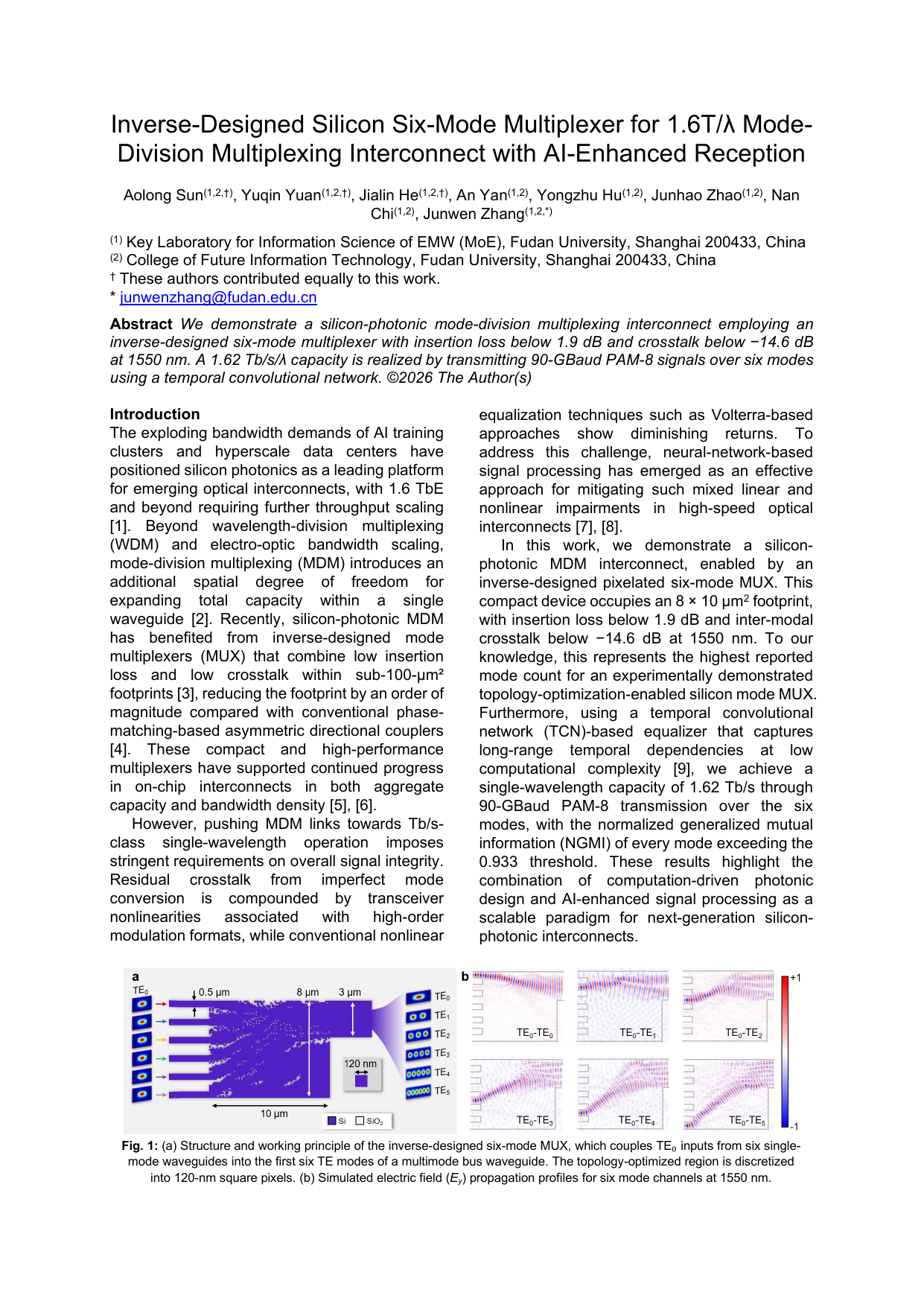
An inverse-designed pixelated six-mode multiplexer (8 × 10 µm²) — to our knowledge the highest mode count for an experimentally demonstrated topology-optimized silicon mode MUX — with insertion loss below 1.9 dB and crosstalk below −14.6 dB at 1550 nm. Combined with a temporal convolutional network (TCN) equalizer, 90-GBaud PAM-8 transmission over the six modes reaches a single-wavelength capacity of 1.62 Tb/s/λ (16.36 bit/s/Hz).
Highlights
- Inverse-designed pixelated six-mode MUX (TE₀–TE₅), 8 × 10 µm² footprint, 120-nm foundry-compatible pixels on 220-nm SOI, via edge-guided analog-and-digital optimization (EG-ADO)
- Highest reported mode count for an experimentally demonstrated topology-optimization-enabled silicon mode MUX
- Measured insertion loss < 1.9 dB and inter-modal crosstalk < −14.6 dB at 1550 nm; flat across the C-band with < 0.6 dB degradation over 1530–1565 nm
- A temporal convolutional network (TCN) equalizer captures long-range temporal dependencies at low complexity, outperforming FFE and Volterra and keeping all six modes above the 0.933 NGMI threshold
- 90-GBaud PAM-8 over six modes → 1.62 Tb/s single-wavelength capacity and 16.36 bit/s/Hz aggregate spectral efficiency
Citation
A. Sun, Y. Yuan, J. He, et al., "Inverse-Designed Silicon Six-Mode Multiplexer for 1.6T/λ Mode-Division Multiplexing Interconnect with AI-Enhanced Reception," 52nd European Conference on Optical Communication (ECOC 2026), Málaga, Spain, Sept. 2026.